


The strange genius of Nathan Fielder, explained in 5 episodes
The strange genius of Nathan Fielder, explained in 5 episodes

Randall Colburn, Britt Hayes, Brianna ZiglerSat, October 17, 2026 at 7:01 PM UTC
0

Nathan Fielder watching Elizabeth Holmes in ‘You Can See Everything’Credit: A24
What is Nathan Fielder’s deal?
It’s a question people have been asking since the Canadian comedian, actor, and filmmaker broke out in the U.S. with Comedy Central’s Nathan for You, a series in which Fielder, who “graduated from one of Canada’s top business schools with really good grades,” helps struggling businesses try out radical, ridiculous, and sometimes brilliant new strategies for attracting customers. While ostensibly a satire of expert-saves-struggling-businesses shows like Kitchen Nightmares or The Profit, Nathan for You frequently transcended its own premise, becoming an unexpectedly revealing exploration of loneliness, human connection, and the increasingly blurry line between reality and performance.
But who is Nathan Fielder? Is his trademark awkwardness just a put-on? What about the loneliness that seeps through his interactions with others? How much of the Fielder we see on screen is a character, and how much is the real thing? “There’s only about a 10 percent difference between the Nathan on the show and real-life Nathan,” Nathan for You co-creator Michael Koman told Rolling Stone in 2017. “The character is just an amplified version of him.”
In the years since, Fielder has pushed those questions into increasingly strange and psychologically complex territory. HBO’s The Rehearsal takes his desire for control to absurd extremes, while Showtime’s The Curse probes the vanity, self-deception, and questionable motives lurking beneath seemingly good intentions. Both shows are hilarious, but there’s an unnerving quality to both that can make even the most mundane interactions feel fraught with existential dread. His comedy doesn’t just make us uncomfortable; it makes us question why we’re uncomfortable in the first place.
Now Fielder is bringing that sensibility to A24’s You Can See Everything, a documentary about disgraced Theranos founder Elizabeth Holmes that he codirected with Primetime filmmaker Lance Oppenheim. Given Fielder’s fascination with authenticity, deception, and the personas people construct for themselves, it’s a fascinating pairing. And while you don’t need to be familiar with Fielder’s previous work to appreciate the new film, newcomers may benefit from a brief introduction.
So, consider this your field guide to Nathan Fielder: five essential television episodes that will help you make sense of his whole... thing.
01 of 05
Nathan for You, “Dumb Starbucks”
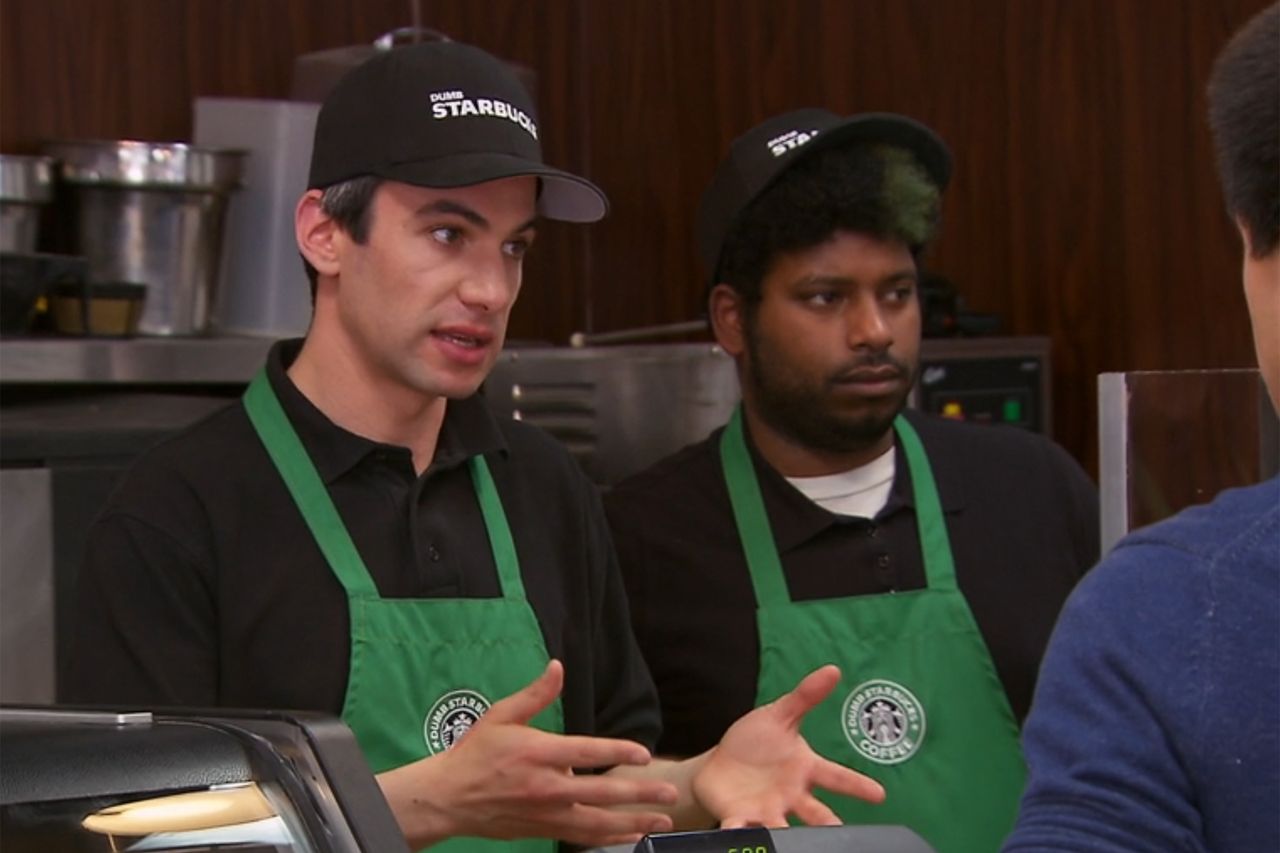
Nathan Fielder on ‘Nathan For You’Credit: HBO
In the fifth episode of Nathan for You’s second season, Fielder attempts to revitalize a struggling coffee shop in the shadow of Starbucks by taking the idea of “If you can’t beat them, join them” to an absurd extreme. Fielder proposes to Helio Cafe’s owner that he rebrand as a Starbucks parody shop, a move that could potentially divert Starbucks customers to “Dumb Starbucks” by exploiting fair-use protections for parody.The “Dumb Starbucks” episode sees Fielder exploring multiple threads that would become signatures of his later work: manufacturing elaborate replicas of reality, usurping a narrative for his own self-serving ends, and not only blurring the lines between real life and television, but also between Fielder as a person and Fielder as persona. Fielder first tries to brute-force a history for himself as a parody artist in order to lend credibility to his claim that Dumb Starbucks is protected under fair use (even putting on his own fake art gallery). But when the Helio Cafe owner decides he doesn’t want to participate in more open mics featuring parody songs like “Shave Tonight” and “I Can’t Get No Erection,” Fielder axes him from Dumb Starbucks. Instead of helping a small business, as is the “purpose” of Nathan for You, Fielder subsumes the plot of the episode for himself.“Dumb Starbucks” ultimately becomes a meditation on the folly of Fielder’s own ego and concludes on a note of apparent remorse towards his treatment of the cafe owner, after Dumb Starbucks gains international media attention and is reportedly shut down for lacking necessary public health permits. Fielder then has an epiphany: “In building Dumb Starbucks, I became someone that I never wanted to be.” However, the joke of this revelation is that it’s likely not even true: As with much of Fielder’s work, the audience is not meant to really know where Fielder’s truth begins and the episode’s construction ends. —Brianna Zigler
02 of 05
Nathan for You, “Finding Frances”
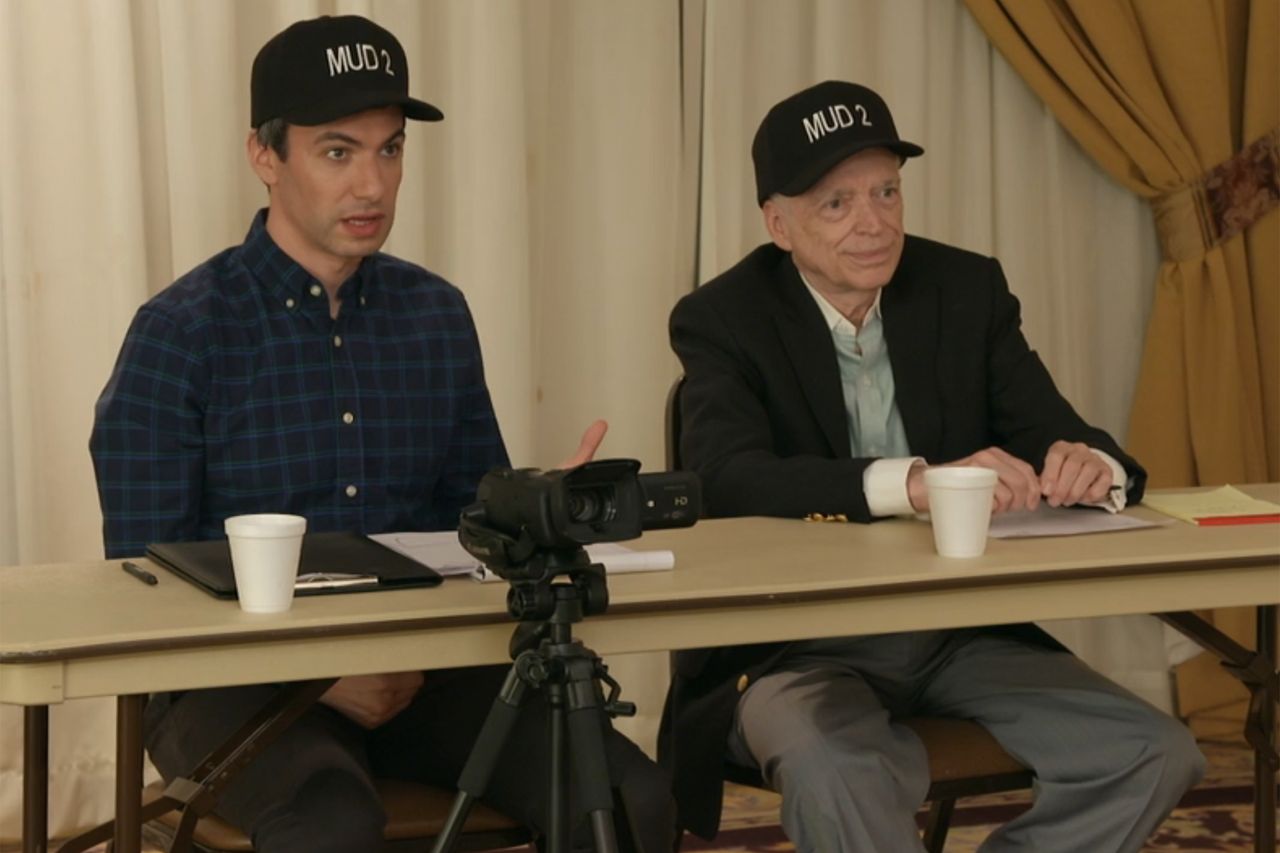
Nathan Fielder and Bill Heath on ‘Nathan For You’Credit: HBO
“Finding Frances” isn’t just a series finale. The nearly 90-minute episode — a film, really — is the culmination of four seasons of Nathan for You. It’s the rug that pulls everything together. And then Fielder pulls the rug out from under our feet.In “Finding Frances,” Fielder reunites with Bill Heath, a Bill Gates impersonator he hired for a season 2 episode about a souvenir shop. As it turns out, Heath has since become a regular fixture at the Nathan for You production office, where he often talks about his desire to reconnect with his high-school girlfriend, Frances Gaddy, the one who got away.
What starts as a somewhat typical Nathan for You episode, involving a fake sequel to the Matthew McConaughey drama Mud, turns into an uneasy road-trip buddy movie. As Fielder and Heath become more acquainted, we start to understand why the latter is so determined to find Frances, and perhaps why he’s still a bachelor in his 70s.
In the final stretch of the episode, Fielder plants the seeds for The Rehearsal when he hires an actress to role-play Heath’s hypothetical reunion with Frances, resulting in a series of incredible scenes that split the difference between adult acting class and therapy. The episode arrives at unexpected conclusions for both Heath and Fielder, whose connection with an escort seems genuine — though it could just as easily be the satisfying payoff to a narrative that Fielder’s been constructing for four seasons.
There are running themes in Fielder’s projects (the human capacity for credulity, loneliness, and performance), but more impressive is the way that each episode and season builds on the last, like a Russian nesting doll in reverse. We’re never entirely certain if Fielder is playing a character — presumably he is, but that uncertainty, coupled with our desire to believe that what we’re seeing is reality, is essential to the viewing experience. —Britt Hayes
Advertisement
03 of 05
The Rehearsal, “Orange Juice, No Pulp”
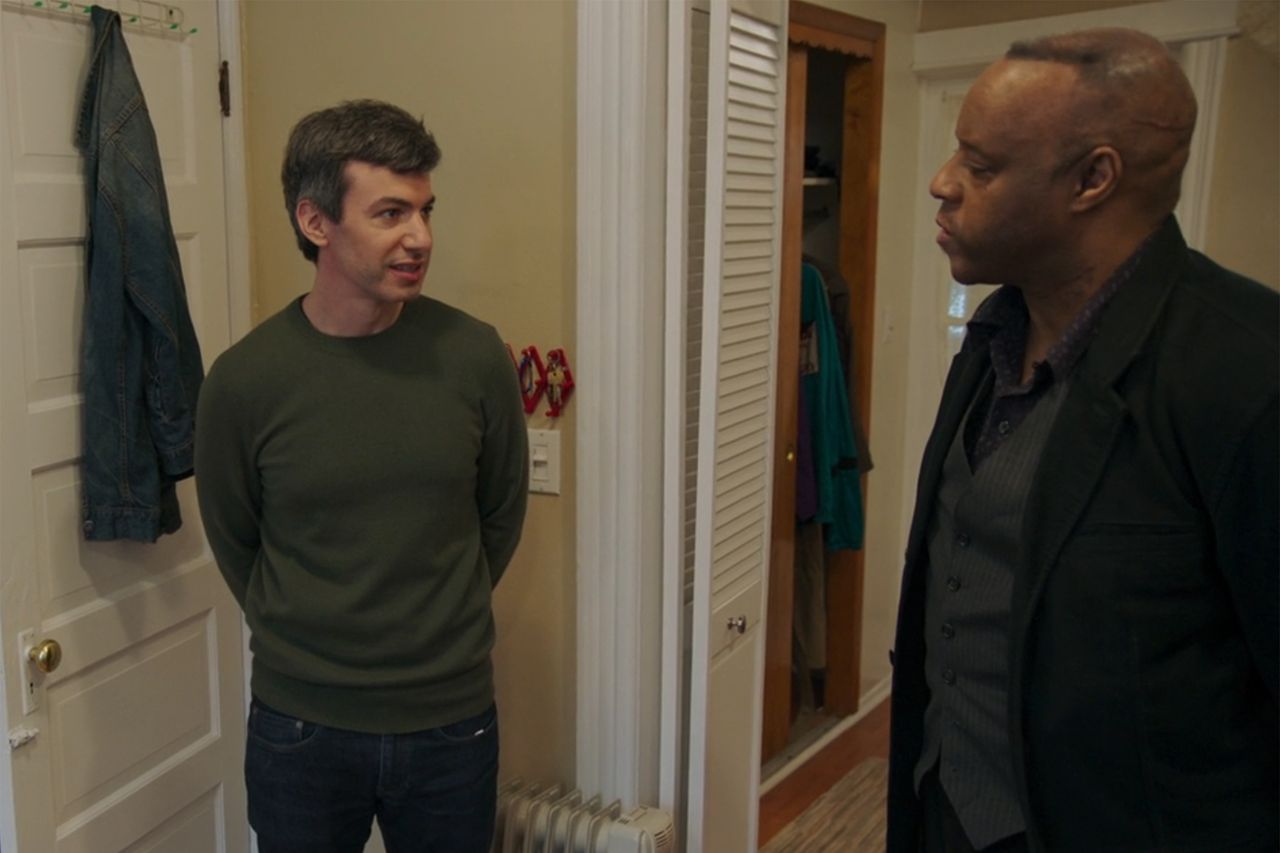
Nathan Fielder and Kor Skeete on ‘The Rehearsal’Credit: HBO
The first episode of The Rehearsal almost feels like a Nathan for You episode with a much higher production budget, but you get the sense that there’s something bigger and more maniacal lurking underneath the surface. Fielder meets with a man named Kor Skeete, a trivia nerd who plays with a team at a local bar every week. Kor needs help telling one of his teammates that he lied about having a master’s degree.In order to pitch his plan to Skeete, Fielder reveals the engine behind The Rehearsal: Prior to that day, Fielder recreated Skeete’s apartment and hired an actor to play him so he could rehearse the entire meeting. This is how Skeete is going to rehearse coming clean to his teammate — in a replica of the bar where he plays trivia, complete with an entire ensemble of actors playing everyone from fellow patrons to bartenders.Even that is too simplistic a description of what The Rehearsal ultimately becomes over its first season, as the second episode makes clear. It’s an exhilarating and occasionally uncomfortable exploration of performance in which Fielder plumbs the depths of the adage “Fake it till you make it.” What if you could rehearse life’s most challenging moments before they happen? What if you could anticipate every possibility — and your reactions — through practice? Would it make real life any less real? Would you be a better person for it? —B.H.
04 of 05
The Rehearsal, “Pilot’s Code”
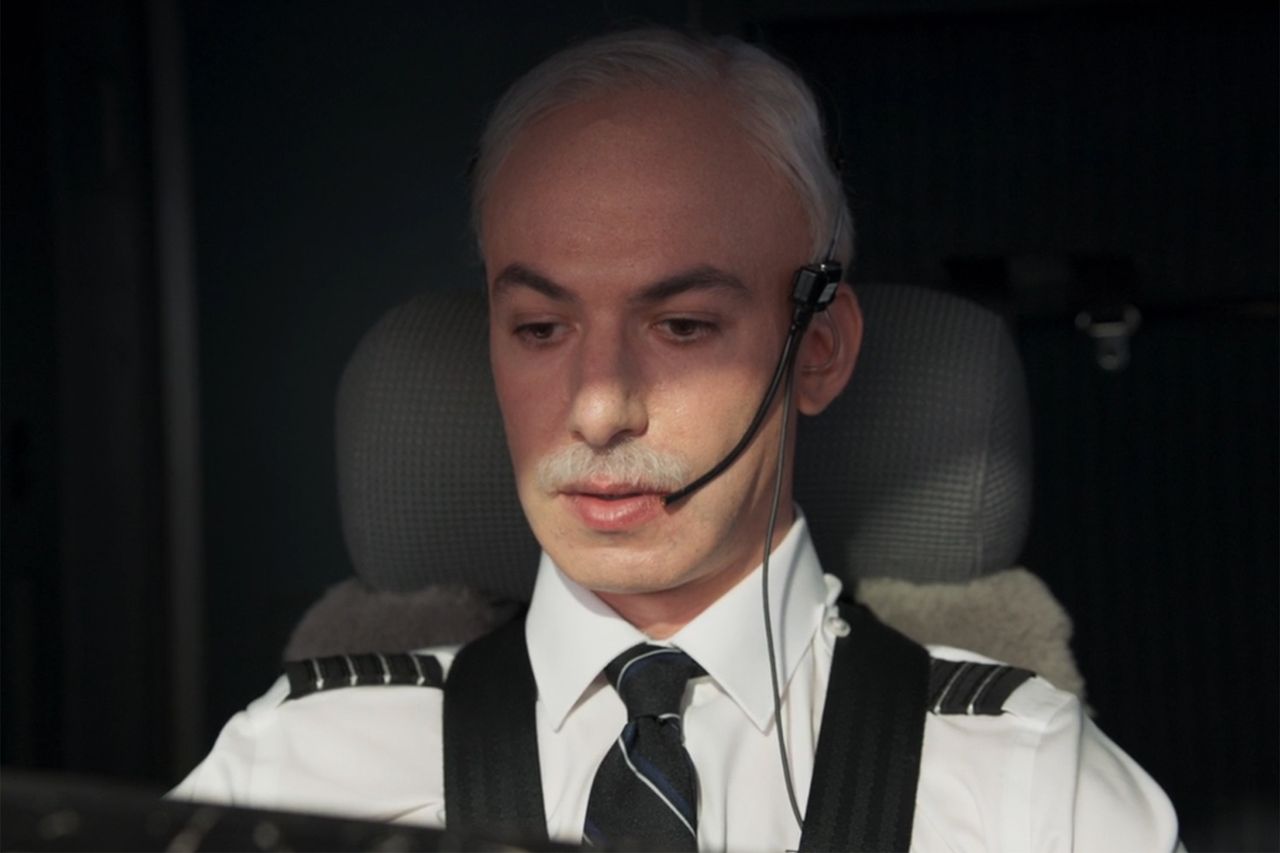
Nathan Fielder on ‘The Rehearsal’Credit: HBO
Season 2, episode 3 of The Rehearsal, “Pilot’s Code,” has Fielder taking his interest in staged reality to extremes through his experiments in solving the pilot communication problem that serves as the season-long arc. Through an absurd stream-of-consciousness scenario, the 34-minute episode begins with a couple who cloned their beloved dead dog and ends with the hypothetical discovery that Sully Sullenberger may have been listening to Evanescence as he landed US Airways Flight 1549 in the Hudson River.Fielder spends the season trying to prevent commercial airplane crashes, which he believes can result from poor communication between pilot and copilots. Trying to discover how Sully was able to successfully land a disabled plane, Fielder first investigates whether clones of a dog can be conditioned by recreating the environments the original dog lived in. He takes the findings from that a step further, attempting to live out Sullenberger’s own life to see if someone could develop the same traits that enabled the pilot to avert a devastating crash and effectively communicate with his copilot.The highlight of the bizarre episode is watching Fielder role-play a “greatest hits” reel of crucial moments in Sully’s life as gleaned from his memoir, in which Fielder imagines himself as Sully as a baby, a teenager, and eventually an adult. Some of the things that can be seen during this section include towering puppets portraying Sully’s parents with ghoulish elongated limbs and, in the case of Sully’s mother, a fully lactating nipple that drowns Fielder as he sucks on it. On its own, the episode serves as a hilarious culmination of Fielder’s preoccupation with seeing whether life can be “rehearsed” in order to achieve tangible results, and in the end, the ludicrous journey the episode takes leads to a troubling observation about pilots’ reluctance to discuss their mental health.But at one point, Fielder tells the audience something crucial through voiceover: “This wasn’t a performance for you, the viewer. It was an experience for me.” Therein lies the psychological crux of Fielder’s work starting with Nathan for You, and what serves as the ultimate bombshell of the season finale. Much of Fielder’s work begins under the guise of helping others, and later becomes an exploration of himself. Again, here is Fielder playing with audience perception of who he really is versus who we’re seeing on screen — leaving us unable to discern how different the two really are. Is the Fielder persona as much of a self-interested and near-diabolical Machiavellian mastermind as he presents himself to be? It seems like only Fielder himself knows, and that’s the point. —B.Z.
05 of 05
The Curse, “Land of Enchantment”

Nathan Fielder and Emma Stone on ‘The Curse’Credit: Hulu
Fielder created this ambitious and unnerving scripted Showtime series with actor and filmmaker Benny Safdie (The Smashing Machine), interrogating the reality TV industry while navigating prickly themes of exploitation, class, gentrification, liberal guilt, and masculinity. Yeah, it’s a lot.
The Curse offers Fielder his meatiest role to date as Asher Siegel, who, along with his wife Whitney (Emma Stone), is filming an HGTV pilot about their efforts to develop eco-conscious housing in the small New Mexico city of Española. As Whitney puts it, the hilariously titled Fliplanthropy “documents Asher and I in our efforts to conscientiously rejuvenate distressed homes.” Of course, their supposedly altruistic endeavor is also a business venture, one that threatens to displace the very people they’re claiming to help.
The project becomes complicated, however, by Asher and Whitney’s marriage troubles, the looming influence of Whitney’s wealthy slumlord parents, and the machinations of boorish producer Dougie (Safdie), who routinely manipulates the couple in an effort to mine drama from the show’s dry premise.
Get your daily dose of entertainment news, celebrity updates, and what to watch with our EW Dispatch newsletter.
All of this is set up in the first episode, “Land of Enchantment,” which wastes no time exposing the darker shades of reality TV production and Asher’s insecurities about his career and manhood, the latter in ways that might make you clutch your pearls.
Stick with it, though, as the series serves as a fascinating exploration of Fielder’s obsession with “performing reality.” Not only are Asher and Whitney different people on camera than off of it, but their marriage and philanthropy are performances in their own right. Their attempts to convince the world that they’re good people are inextricably linked to their desire for success, and it’s not entirely clear how much they believe their own act. As a director, Fielder heightens this uncertainty by shooting his characters voyeuristically, peering through windows, doorways, and even peepholes, as though we’re spying on moments we were never meant to see.
That queasy relationship between observation and authenticity makes The Curse a compelling precursor to You Can See Everything. When everyone is performing for someone, how can we trust anything we see? —Randall Colburn
on Entertainment Weekly
Source: “AOL Entertainment”
